

What is bowel cancer?
Bowel cancer is sometimes known as colon, rectal, or colorectal cancer. It affects the large bowel – which sits in your abdomen, is part of your digestive system, and makes up your colon and rectum (back passage).
Every 15 minutes someone is diagnosed with the disease, that’s nearly 43,000 people each year. Bowel cancer is the UK’s second biggest cancer killer, but it shouldn’t be because it’s treatable and curable especially if diagnosed early.
Nearly everyone survives this cancer if diagnosed at the earliest stage but this drops significantly as the disease develops. Early diagnosis really does save lives.
Who can get bowel cancer?
Bowel cancer is more common in people aged 50+, but more than 2,600 [BCUK] new cases are diagnosed each year in people younger than this. It affects both men and women – 1 in 15 men and 1 in 18 women [CRUK] will be diagnosed with bowel cancer.
Some cancers can be caused by genetic conditions such as Lynch Syndrome. Lynch Syndrome accounts for approximately 3 to 5% of all bowel cancers. All patients should be tested for this when they are diagnosed with bowel cancer. This enables them to be appropriately followed up and their family can be counselled for testing also.
Bowel cancer screening
Test kits for poo (FIT tests) are sent to people aged 60-74 in England, every two years, to check for cancer of the bowel. This is being extended to everyone aged 50+ years before 2025, so you may be sent a test before you’re 60. If you receive your kit in the post, do it and return it. If you don’t receive one, or you’re aged over 75, call 0800 707 6060 to request a kit.
The FIT test is easy to do and could save your life. View this video to see how easy it is.
What are the signs and symptoms?
Knowing the symptoms of bowel cancer could save your life:
- bleeding from your bottom and/or blood in your poo
- changes in your bowel habits – eg constipation or diarrhoea – that continue and can’t be explained
- unexplained or sudden weight loss
- feeling tired or breathless for no obvious reason
- a pain or lump in your tummy or your back passage
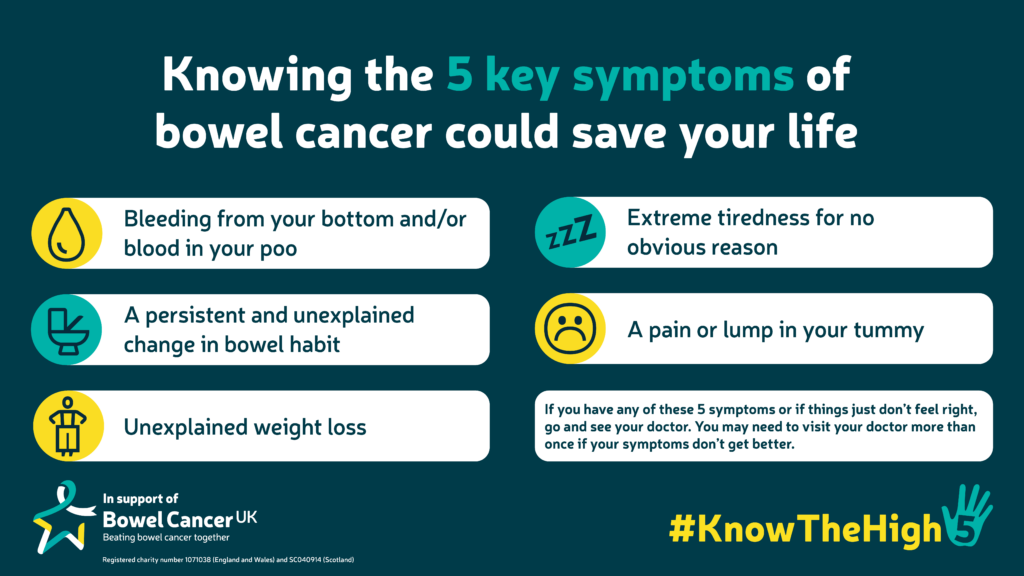
If you have any of these symptoms for three+ weeks, see your GP. Your symptoms could be for another common condition including piles (haemorrhoids), constipation, diarrhoea, or irritable bowel syndrome (IBS). Most people who get checked find out it’s not cancer but detecting it earlier makes it easier to treat.
How do you reduce your risk?
Do your FIT screening test when you receive it (see above).
Some of the risk factors of cancer in the bowel are unavoidable – including your age or any family history of bowel cancer. Your risk increases if your parent, brother or sister, or child has been diagnosed with bowel cancer – especially if they were under age 45, or if more than one relative has had bowel cancer. These conditions may also increase your risk:
- a history of polyps (non-cancerous growths) in your bowel
- Crohn’s disease or ulcerative colitis
- Type 2 diabetes
- Lynch syndrome – an hereditary condition caused by a gene which increases the chance of developing bowel cancer
And certain lifestyle choices can reduce your risk, including:
- eating a diet which is low in red meat or processed meats
- eating a diet which is high in wholegrains, fibre, fruit, vegetables, and pulses
- being a healthy weight
- drinking around 2 litres of water a day (and reduce sugary drinks and fruit juices)
- moving more – at least 30 minutes of physical activity, five times a week
- reducing alcohol intake – around 6 in 100 bowel cancers (6%) are linked to alcohol
- not smoking – smokers are more likely to develop polyps which can turn into cancer if left undetected. Cancer of the bowel risk increases with the number of cigarettes smoked – around 7% of bowel cancer cases in the UK are smoking-related
FP: 19/04/2022
LU: 23/05/2023
NU: 23/05/2024