
UK cases of melanoma skin cancer have doubled since the 1990s. This makes skin cancer the most common cancer diagnosed in England [BAD].
What is skin cancer?
There are two usual types of skin cancer:
Non-melanoma
Non-melanoma skin cancers develop in the upper layer of your skin, usually on the areas which are most exposed to the sun such as your face, ears, hands, shoulders, upper chest, and back. Basal cell carcinoma is the more common, and also squamous cell carcinoma. Both these types of skin cancer don’t spread to other parts of your body.
Non-melanoma skin cancer is more common and usually less serious than melanoma.
The first sign of non-melanoma skin cancer is usually the appearance of a lump or discoloured patch on the skin that persists after a few weeks and slowly progresses over months or sometimes years. This is the cancer, or tumour.
Melanoma
Melanoma is the less common type of skin cancer and starts in the cells that give skin its colour. In white skin it’s usually first visible as a new mole or an existing mole that has changed. However in brown or black skin it can develop on feet or hands or under nails, or in the mouth.

The changes to the cells are caused by damaged DNA so they grow and multiply excessively. If left untreated they can spread through the lymph system and blood vessels and then spread to other parts of the body. Because melanoma has a risk of spreading, it is the more serious condition but 86% of cases of melanoma are preventable if you can protect your skin from the sun [NHS]
Melanomas can happen anywhere on the body – in women, most commonly on the legs, and in men, on their backs. They are uncommon in areas that are protected from the sun, such as on the scalp or buttocks.
Less common cancers
Less common cancers include Merkel cell carcinoma, Kaposi’s sarcoma, T cell lymphoma of the skin, and sebaceous gland cancer.
Who can get skin cancer?
Skin cancer doesn’t discriminate between skin types or a person’s sex.

One in 36 men will be diagnosed with melanoma in their life time, and one in 47 women. The greater number of men is not because they are at greater risk from being male, but because they are less inclined to use sunscreen to protect their skin from damage.
The incidence of skin cancer in England increased from 177,677 in 2013 to 224,092 in 2019 – an increase of more than 25% in six years [BAD]. But no single reason is responsible. Instead, the rise in cases may be due to a combination of:
- an ageing population
- how we behave in the sun
- because greater awareness leads to more cases being identified
Checking for skin cancer
You’re encouraged to know your skin and be aware of any changes to moles and freckles. Learn how to check your skin following the ABCDE method. Regular self-checking will allow you to notice even small changes which you can then monitor.
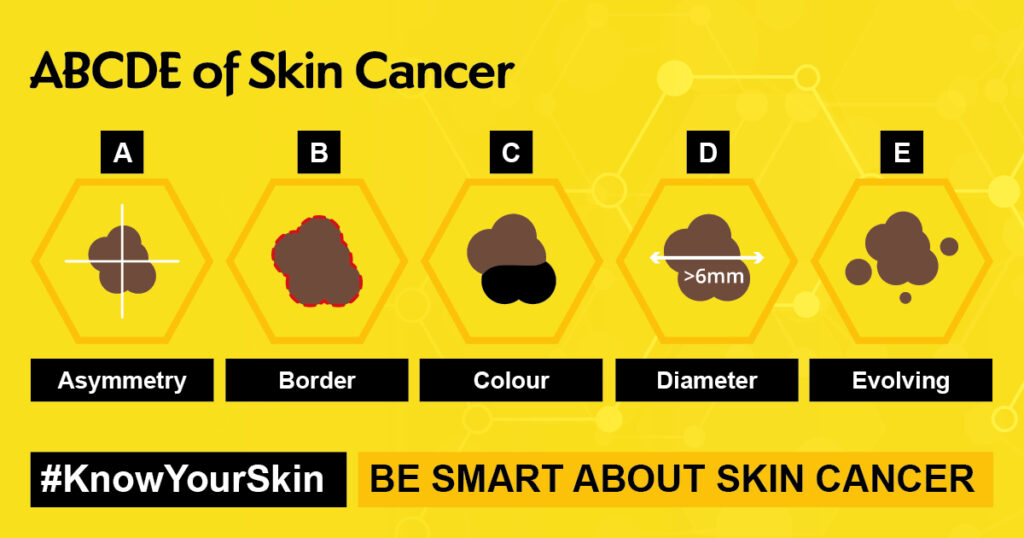
See a GP if you have any skin abnormality, such as a lump, ulcer, or skin discolouration that has not healed after four weeks. If your GP is concerned, they can refer you through the NHS to a skin cancer specialist, usually a Consultant Dermatologist – an expert in diagnosing these cancers. While it may not be skin cancer, it’s best to get it checked.
Don’t rely on smartphone apps which use AI to check moles and freckles. The British Association of Dermatologists (BAD) warns against the use of smartphone apps to monitor moles and freckles as they don’t meet regulatory standards for medical devices. If you’ve done the visual ABCDE check and are concerned, contact your GP surgery for advice
The outcome [BAD] for early-stage melanoma (stage 1) is excellent, with almost all patients surviving for at least five years after diagnosis. This drops to around 25% five-year survival for stage 4 melanoma, highlighting the importance of the early detection and treatment of melanoma.
How do you reduce your risk of skin cancer?
If you have more than five sunburns, you double your risk of melanoma skin cancer.
And yet, data from British Association of Dermatologists, shows that 40% of people in Great Britain reported at least one case of sunburn in 2022. This rose to more than half (56%) of young people (aged 18-34).
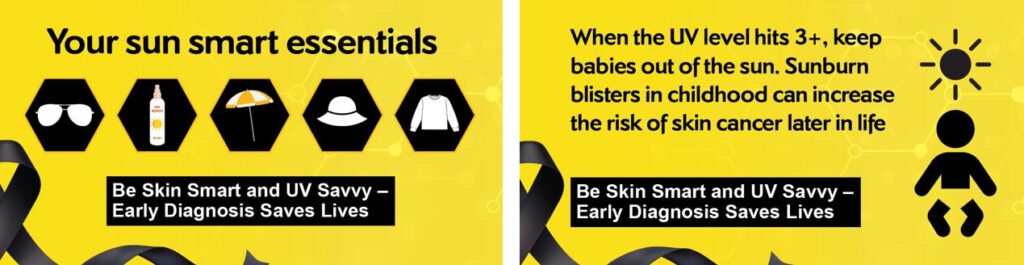
Babies should be kept out of the sun completely and children should be protected with clothing, sunscreen, and shade. But everyone needs to protect their skin from the sun to reduce their risk, and you need to be extra-cautious if you:
- have had a previous non-melanoma skin cancer
- have a family history of skin cancer
- have a pale skin that burns easily
- have blond or red hair
- are in older age
- have a large number of moles or freckles
- take medicine or have a medical condition that suppresses your immune system
- have been exposed to chemicals such as creosote or arsenic
You can minimise your risk of developing cancer of the skin by practising sun safety:
- check the UV levels of the day – not just the sun or rain forecast. Usually you should protect your skin, when the UV level is 3+
- use high factor sunscreen – preferably a broad spectrum sunscreen of SPF 30+ every two hours
- dress sensibly in the sun – cover your skin with cool loose clothing, wear a hat with a brim or a peak, and wear dark glasses
- limit the amount of time you spend in the sun during the hottest part of the day (11am-3pm). Choose a shady spot instead
- completely avoid sunbeds and sunlamps – in some countries sunbed tanning salons are banned because sunbeds emit ultra-violet radiation which leads to genetic defects and mutations which cause these cancers
FP: 24/05/2022
LU: 20/07/2023
NU: 20/07/2024